REVIEW · VENICE
Secret Venice, an unusual walk – Private Walking Tour
Book on Viator →Bookable on Viator
Venice has a way of hiding what matters. This tour is built for the alleys, courtyards, and small details that usually slip past you. I like that it mixes big-name art with street-level stories, and you get plenty of Q&A because the group stays small. I also love how it connects Venice themes you hear about—water, Carnival, and the city’s past—to places you can actually stand in. The only drawback to plan for is the pace: it’s a steady walk with about 15 minutes per stop, so if you want long, slow museum-style time, you’ll likely need extra free time on your own.
You’ll take a guided, mobile-ticket walk in English for about 2 hours, starting near Campo San Giacomo di Rialto at 11:00 am and ending at Campo San Rocco in front of the Scuola Grande di San Rocco. It’s private (just your group), with admissions for the scheduled stops listed as free, and it’s designed for good-weather conditions.
In This Review
- Key highlights worth planning for
- A small Venice walk that swaps crowds for stories
- Group size and pace: how you keep control of the questions
- Price in plain numbers: what $453 per group really means
- Rialto start to red-light canal: your 2-hour route
- Stop 1: Chiesa di San Giacomo di Rialto
- Stop 2: Mercati di Rialto
- Stop 3: Rio Terà de le Carampane (former red-light district)
- Stop 4: Campo San Polo (wells and the altana)
- Stop 5: Campo San Toma (Carnival and the importance of masks)
- Church art stops: Titian and Tintoretto in their home churches
- Stop 6: Basilica di Santa Maria Gloriosa dei Frari
- Stop 7: Scuola Grande di San Rocco
- Practical tips for a smooth walk on cobblestones
- Who this tour suits best
- Should you book Secret Venice or pick something else?
- FAQ
- Is this tour private?
- What language is the tour offered in?
- How long is the walking tour?
- Where does the tour start and end?
- What time does it start?
- What’s the group size?
- Are there tickets or admissions to pay during the stops?
- Is there an access fee on some dates?
- What happens if the weather is bad or I need to cancel?
Key highlights worth planning for
- Small-group feel (capped at eight), so you can ask real questions instead of racing to the next photo
- Church art in context, with Titian and Tintoretto connected to the churches where it was made
- Rialto market + merchant stories in the same area locals actually move through
- Rio Terà de le Carampane used as a lens to explain Venice’s former red-light district
- Venice’s water clues in Campo San Polo, including why wells are scarce and how altanas fit in
A small Venice walk that swaps crowds for stories
Venice can be intense. You step out of a vaporetto stop, look up, and suddenly you’re in a flood of people, pigeons, and postcard views. This private walk is different because it keeps you focused on a tighter stretch and a smarter rhythm. You’re not trying to conquer the whole city in two hours. You’re learning how Venice works—socially, artistically, and even physically—by stopping in the right places.
What makes it feel special is the mix. Yes, you’ll see major church sites. But the guide also ties in everyday Venice realities: Rialto’s merchant power, the city’s old carnival traditions, and how Venice handled water. That blend is what turns a simple walking loop into something you’ll remember later, even after you’ve moved on to another neighborhood.
You can also read our reviews of more walking tours in Venice
Group size and pace: how you keep control of the questions
This is offered in English and capped at eight people. For me, that small number matters more than almost anything else on a city-walk. In big groups, you get “follow the leader” history. Here, the structure is designed so the guide can slow down when someone wants clarification.
The typical stop rhythm is about 15 minutes each. That sounds short, but it works because every stop is specific: one church, one square, one canal-level story, one theme. You won’t get stuck in a single place waiting for the group to catch up. At the same time, because the group is small, questions don’t feel like an interruption. They’re part of the plan.
Practical note: because you’re moving every so often, wear shoes you’d actually walk in for an hour on uneven stone. Venice does not care if you’re on vacation.
Price in plain numbers: what $453 per group really means
The price is $453.01 per group, up to 15. That sounds steep until you translate it into per-person math, and then the value story gets clearer.
- If you’re traveling as a small group of 2, the cost per person is high.
- If you’re 6 to 8 people, it becomes much more reasonable for a private, guided experience that’s designed around a small cap.
- The best value is when you can split the group price among enough people to make the per-person cost feel like a “real” tour day.
Also, the scheduled stops list admission ticket: free for each location on the route. That’s not nothing. It means you’re paying mainly for the guide’s time and expertise rather than a stack of attraction entry fees.
So how do you decide? If you want a private Venice story with a guide who handles questions and connects themes across multiple sites, this pricing can feel fair. If you’d rather pay less and share group space, you might choose a less expensive public walking tour instead.
Rialto start to red-light canal: your 2-hour route
Your walk starts at Campo San Giacomo di Rialto (near the church of San Giacomo di Rialto area). You’ll end at Campo San Rocco, specifically in front of the Scuola Grande di San Rocco. It’s a classic Venice “start near Rialto, finish near San Rocco” arc, and it’s smart because it threads through varied parts of the city without doubling back endlessly.
Here’s how the route builds meaning stop by stop.
Stop 1: Chiesa di San Giacomo di Rialto
This is where the guide frames Venice at a very long time scale—what the city looked like early on, and why this area mattered when Venice was still becoming itself. The charm here is that you’re not just staring at architecture. You’re getting a timeline that helps the rest of the walk click into place.
Why it’s worth your attention: It’s an orientation stop. Once you understand why this area was funded and developed, the later Rialto market talk lands better.
Possible drawback: If you’re hoping for a lot of interior time, the stop is short (about 15 minutes). Expect a guided primer rather than a slow, deep church visit.
You can also read our reviews of more private tours in Venice


Stop 2: Mercati di Rialto
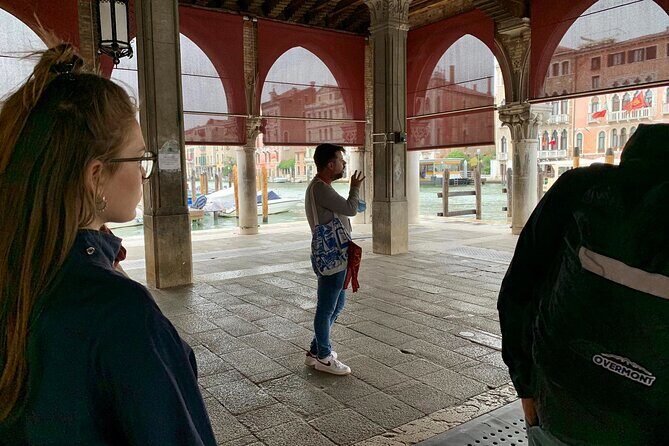
Rialto isn’t only postcard Rialto. It’s merchant Venice. This stop is designed to explain how Venetian merchants thought, worked, and influenced the city’s day-to-day life. If you like travel that’s part economics and part human stories, this is your moment.
Why it’s worth it: You learn what kind of people shaped Venice’s power—so the buildings don’t feel random.
Watch for: Markets can be busy. Even on a quiet day, you’ll want to stay aware and keep moving with the guide so you don’t get bounced around by foot traffic.
Stop 3: Rio Terà de le Carampane (former red-light district)
This is one of the most interesting theme stops on the walk because it uses location to explain a chapter of Venice life. The guide shares stories and curiosities about the former red light district, but the goal isn’t shock value. It’s context: why certain areas became known, and how Venice’s social rules shaped street life.
Why it’s worth it: You’re connecting a name you may have seen on a map to what it meant historically.
Possible drawback: If you’re sensitive to adult-history topics, decide in advance. The tour is described as stories and curiosities, but you should know the subject is part of the route.
Stop 4: Campo San Polo (wells and the altana)
Here you get one of Venice’s “how does this even work?” explanations. The focus is on why Venice has so few wells, plus the idea of the altana—the rooftop terrace system you often see in Venetian buildings.
This stop turns what looks like decoration (rooftops and ledges) into a practical design story. In Venice, water access wasn’t simple like it is in inland cities. Many areas relied heavily on rainwater collection and storage systems rather than easy, reliable wells. So when the guide talks about scarce wells, it helps you understand why you see other water solutions everywhere.
Why it’s worth it: It gives you a physical explanation for something that seems mysterious at first.
Watch for: You’ll be standing in open air for a short segment, so bring something for sun or wind depending on season.
Stop 5: Campo San Toma (Carnival and the importance of masks)
Carnival is one of Venice’s best-known traditions, but the guide treats it like more than costumes for photos. This stop focuses on masks and why they mattered—socially, culturally, and how the city allowed certain kinds of anonymity or role-play.
There’s also a practical perk tied to this stop: some people note mask-making as something to watch for. Even if you don’t plan your day around it, you’ll likely get a better sense of how the mask world works once the guide puts it into historical context.
Why it’s worth it: You’ll understand masks as a tool, not just an accessory.
Possible drawback: If you’re visiting outside Carnival season, the vibe may be more explanatory than theatrical. You’re there for meaning and history, not for a full festival event.
Church art stops: Titian and Tintoretto in their home churches
Venice church interiors can be overwhelming. Too much marble, too many saints, too many gold frames. This tour’s advantage is that it ties major Renaissance art to the churches where it was painted for. That turns the artwork from “pretty things on a wall” into “intentional commissions with a purpose.”
A key highlight is seeing works by Titian and Tintoretto in the churches they were made for. That connection matters because it changes how you look: you start noticing who commissioned art, who would have seen it, and why it was placed there.
Stop 6: Basilica di Santa Maria Gloriosa dei Frari
This is one of Venice’s major church landmarks. On this walk, it’s not just a photo stop. The guide explains why it’s important and how it fits into Venice’s broader religious and artistic life.
Why it’s worth it: Frari is the kind of church where a guide can help you notice the bigger story faster than you could alone.
Watch for: Again, it’s about 15 minutes. If you want to linger, you’ll need to revisit later.
Stop 7: Scuola Grande di San Rocco
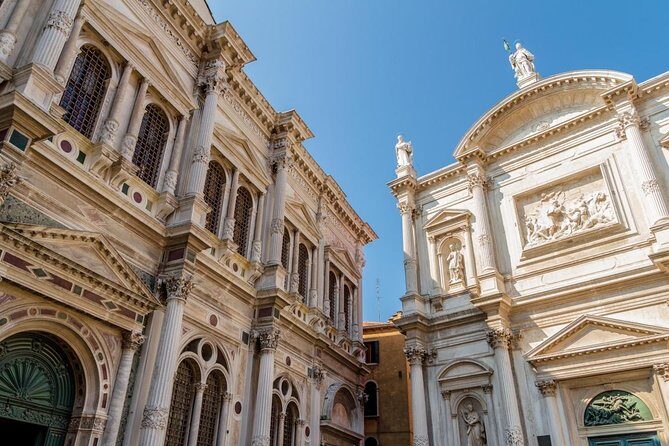
You end at Campo San Rocco in front of the Scuola Grande di San Rocco. This is a fitting finish because it’s visually striking and packed with decoration. The guide explains why the building matters and what you’re looking at when you see its famous richness.
Even if you’re not a “school-of-art” person, this stop works because it connects the architecture and decoration to the people behind it. By the time you reach this location, you’ve already learned how Venice’s institutions expressed power through art and public space.
Why it’s a good ending: The last stop leaves you with images that stick, even after you’ve walked away.
Practical tips for a smooth walk on cobblestones
Venice is romantic, but it is also practical-footwear hostile. This tour moves through multiple squares and church-front areas, and the route includes canal-area storytelling. Plan for:
- Comfortable shoes with grip for uneven stones.
- A light layer if it’s windy or cold when you’re exposed in open squares.
- A phone with enough battery time. You’ll have a mobile ticket, and you’ll appreciate having maps ready if you need a quick orientation.
If you rely on public transportation, this is also a plus. The start and finish are near transit, so you can slot it between other plans without a major logistics puzzle.
Finally, the tour requires good weather. If it’s canceled due to poor weather, you’ll be offered a different date or a full refund. If you’re traveling with flexible plans, that’s comforting.
Who this tour suits best
This tour is a great fit when you want:
- A private, guided walking experience instead of a crowded group.
- Art context, not just art dates.
- A Venice theme tour (water + Carnival + social history) that you can connect to real streets and buildings.
- A guide who can handle questions in a small group format.
It’s also ideal if your group likes food and practical suggestions. One recurring point from past experiences is that guides often include restaurant and other recommendations after the walk. So you leave with a plan for what to do next, not just a list of sites you visited.
Should you book Secret Venice or pick something else?
Book it if you want a focused, private Venice story that mixes big artistic names (Titian and Tintoretto) with street-level themes like the scarcity of wells, altanas, Carnival masks, and the former red-light district. The small-group cap is the real differentiator because it makes the history feel conversational, not scripted.
Pass on it if you’re mainly chasing maximum sights per hour, or if you want long interior time in churches. This is a smart walking guide format, not a slow museum day.
If you’re on the fence, consider your group size. At $453 per group, the best value happens when you can split the price among enough people to make the per-person cost comfortable.
FAQ
Is this tour private?
Yes. It’s a private walking tour, so only your group participates.
What language is the tour offered in?
The tour is offered in English.
How long is the walking tour?
It runs for about 2 hours.
Where does the tour start and end?
It starts at Campo San Giacomo di Rialto (Campo S. Giacomo di Rialto, 30125 Venezia VE, Italy) and ends at Campo San Rocco (in front of the Scuola Grande di San Rocco, 30125 Venezia VE, Italy).
What time does it start?
The start time listed is 11:00 am.
What’s the group size?
The tour format is capped at eight participants.
Are there tickets or admissions to pay during the stops?
The listed stops show admission ticket free for each location on the route.
Is there an access fee on some dates?
On certain dates, people visiting for the day who are staying outside Venice may need to pay a €5 access fee. You can check which days apply at https://cda.ve.it.
What happens if the weather is bad or I need to cancel?
This experience requires good weather. If it’s canceled due to poor weather, you’ll be offered a different date or a full refund. If you cancel, it’s non-refundable and cannot be changed.