REVIEW · VENICE
Venice: Entrance Ticket to the Naval Historical Museum
Book on GetYourGuide →Operated by D'Uva · Bookable on GetYourGuide
Venice’s naval stories start fast. If you like history you can look at (not just read about), the Naval Historical Museum is a focused, walk-through experience with a lot of visual proof. I especially like the way it covers Venice’s maritime roots and then carries the thread to the modern Italian Navy, and I also like that the collection includes ship models, paintings, and documents, not just metal boats behind glass. One drawback to plan for: it’s an entrance ticket for self-paced visiting, so you won’t get a guided narrative to connect every exhibit.
This museum is in a 15th-century building that used to work as the Republic of Venice’s granary, and it sits about a 5-minute walk from Piazza San Marco, right by the Ancient Arsenal area. You’ll also get a time-saver: a separate entrance designed to help you skip the line.
In This Review
- Key highlights to look for
- MUNAV at a glance: the 1.5-hour experience and what you’re paying for
- Where it is by San Marco: how to fit it into a Venice day
- Entering the museum: a 15th-century granary with five floors
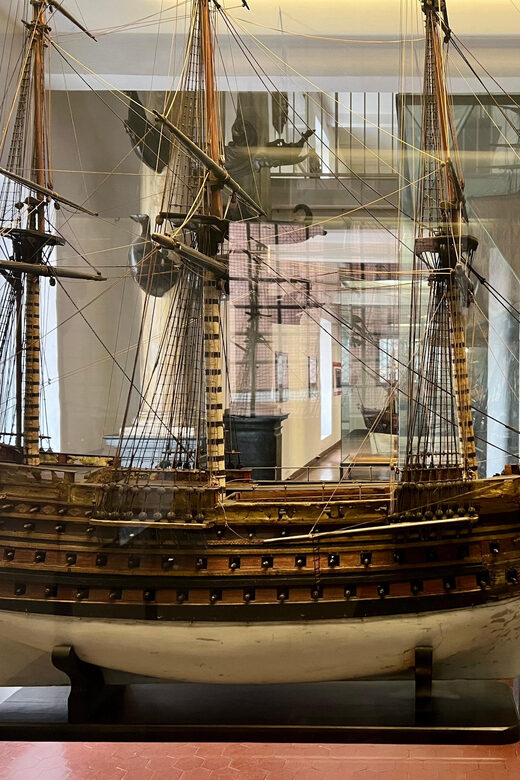
- What you’ll see on the floors: boats, ship models, paintings, and documents
- Venetian boats to modern models: how the museum keeps its timeline coherent
- The Far East collection: a surprising highlight you should plan time for
- Where the artifacts fit: why ship models and documents matter here
- Skip-the-line entrance: a small perk that makes a big difference in Venice
- Price and value: why $18 feels fair for this museum
- Who this ticket fits best (and who may want a guide)
- Small-pet policy: bring yours in, but plan for the carrier
- Should you book this Naval Historical Museum ticket?
- FAQ
- How long should I plan for the Naval Historical Museum of Venice?
- What does the entrance ticket cost?
- What’s included with the ticket?
- Is a guided tour included?
- Can I bring a small pet inside?
- Can I get a full refund if my plans change?
Key highlights to look for
- Venice’s naval story in one ticket: from origins through the modern era, across multiple floors
- Lots of hands-on-looking material: ship models, paintings, and documents alongside vessels
- A standout Far East section with boats and maritime examples from China and the Far East
- Italian Navy ownership and Ministry of Defense management, giving it an official feel
- A built-for-visiting museum layout spread over 5 floors in a 6,000-square-meter space
MUNAV at a glance: the 1.5-hour experience and what you’re paying for
The ticket price is $18 per person for about 1.5 hours of museum time. That’s not just a random surcharge to stand in a line. Here you’re buying entry to the Naval Historical Museum of Venice (often called MUNAV), which is described as the most important naval museum in Italy and is operated under Italy’s defense institutions.
Also, this is a smart value stop because it’s built for short attention spans. One and a half hours is enough time to see the main themes without turning it into a half-day project. If you love maritime details, you can always slow down on the ship-model-heavy parts.
You can also read our reviews of more tours and experiences in Venice



Where it is by San Marco: how to fit it into a Venice day
MUNAV sits in the Veneto region of Italy, and practically speaking it’s close to the places you’re already trying to reach. It’s about a 5-minute walk from Piazza San Marco and near the Ancient Arsenal of Venice. That makes it easy to combine with your regular sightseeing circuit.
The location also changes how the visit feels. You’re not taking a long boat ride or dealing with a big transit plan just to reach a museum. You can pop in between church stops, waterfront walks, or a morning before the biggest crowds.
Entering the museum: a 15th-century granary with five floors
The museum is housed in a 15th-century building that once functioned as a granary for the Serenissima Republic. That old-purpose setting matters because it turns the visit into more than “look at boats.” You’re stepping into a place that used to store essentials for a maritime city, and that context supports the exhibits you’ll see inside.
The museum covers about 6,000 square meters and offers exhibits across five floors. Even if you don’t know a single naval term, the layout helps you move through the story in chunks instead of getting lost in one long hall.
One practical note: five floors can tempt you to sprint. If you do, you’ll miss the quieter sections with documents, paintings, and smaller ship models. I’d rather you go slower and leave with a clear mental picture than rush and feel like you’ve just passed through.
What you’ll see on the floors: boats, ship models, paintings, and documents
Your visit is structured around maritime themes, and you’ll see a mix of mediums:
- Ship models: a strong way to understand design and evolution without needing a full-sized vessel
- Paintings: useful for mood, era, and how people pictured naval life
- Documents and artifacts: the kind of evidence that turns stories into facts
- Historical boat examples spanning from ancient Venetian boats to later periods
The museum experience is essentially a visual timeline. It starts with earlier Venetian maritime tradition, then builds toward more modern Italian Navy material. You’re looking at more than “what ships existed.” You’re also seeing how a maritime culture gets recorded: through plans, records, artwork, and scaled reconstructions.
Because the museum spans multiple floors, you can adjust your pace. If you want the highlights, aim to see each theme once. If you’re a detail person, pick one floor to focus on and give it extra time.
Venetian boats to modern models: how the museum keeps its timeline coherent
One reason this ticket works well for a wide range of people is the range. You get ancient Venetian boats as well as contemporary Italian Navy models, so the museum isn’t locked in one era. That matters because many maritime museums skew either historical or modern. Here, the pairing helps you understand continuity: how a naval identity develops over centuries.
The modern-model part also changes the tone. It adds a sense of present-day purpose to what could otherwise feel like a distant, museum-only world. You start with Venice as a maritime power, then you see how the Italian Navy’s collection and preservation keeps the story going.
If you love ships, this is a good place to compare “then” and “now” without leaving the building.
You can also read our reviews of more historical tours in Venice






The Far East collection: a surprising highlight you should plan time for
The museum includes an exceptional collection of boats from China and the Far East. That alone is worth building your visit around, because it pushes the story beyond the usual Venice-only angle.
In practice, this section can feel like a different kind of maritime education. Instead of only looking at Venetian-era craft, you’re seeing evidence of how maritime technology and ship types traveled and evolved across regions. Even if you can’t read every detail on a label, the sheer variety of examples gives you something concrete to compare.
When you plan your 1.5 hours, I’d treat the Far East section like a “must-hit.” Don’t save it for the last 15 minutes just because you assume you’ll have time.
Where the artifacts fit: why ship models and documents matter here
The naval theme could turn into a single-note show if the museum only had vessels. Instead, it mixes ship models with paintings and documents. That combination is powerful because it tells you how information about ships survives:
- Models show form and engineering ideas
- Paintings show how ships looked and how they were framed visually
- Documents show the administrative and recorded side of maritime life
This is also why the museum tends to land well with people who don’t consider themselves “museum people.” The material is varied. You can be interested in boats, or you can be interested in how the story is preserved.
The standout feedback from real visitors reflects this. People consistently describe it as very beautiful and very informative, and they also note it feels appropriate for a broad audience. That matches what the collection is built to do: teach without being intimidating.
Skip-the-line entrance: a small perk that makes a big difference in Venice
Venice is Venice, and waiting is rarely your friend. This ticket includes a skip-the-line option through a separate entrance. That doesn’t sound like a big deal until you’re standing on the edge of a busy square with limited time.
This is the kind of practical feature that helps you keep the day smooth. You’re already near Piazza San Marco, so the museum can become a straightforward stop instead of a timed battle.
If you’re visiting at peak hours, this helps a lot. If you’re flexible and can go at a quieter time, even better.
Price and value: why $18 feels fair for this museum
Let’s talk value, not just cost. For $18, you get access to one of Italy’s key naval museums, run under Italy’s defense structures, with exhibits spanning five floors and a 6,000-square-meter footprint. You’re not paying for a tour guide voice; you’re paying for the museum’s breadth and the chance to explore it at your pace.
Is it “cheap”? Venice rarely offers cheap. But compared to many small-ticket attractions, this feels like money spent toward a real subject matter and a real collection. The ticket also matches the time commitment well: 1.5 hours is long enough to benefit, but short enough to stay practical.
The only real downside on value is also the only real downside on format: there’s no guided tour included. If you really want someone to narrate connections between exhibits, you’ll need to do that yourself by reading labels more carefully than you might elsewhere.
Who this ticket fits best (and who may want a guide)
This museum suits you if:
- You like ship models, artifacts, and documents rather than only large-scale displays
- You want a stop that connects Venice’s maritime past to the modern Italian Navy
- You’re looking for something educational but visually oriented
- You’re traveling with a mixed group and want a museum that doesn’t require expert knowledge
It may be less ideal if:
- You want a structured, spoken story throughout the visit (since it’s self-paced)
- You only have a short time and tend to rush museums, because five floors can pull you into extra wandering
For the “I’m curious but not a specialist” crowd, it’s a strong match. The format is designed to be accessible, and the content gives plenty of hooks.
Small-pet policy: bring yours in, but plan for the carrier
If you’re traveling with a pet, note the rule: small pets are allowed if they are carried in their own carrier or held in arms during the visit. Guide dogs are exempt from this rule.
This is useful to know before you buy your ticket and show up with an animal setup that isn’t supported. Venice walking streets can be tiring for both people and pets, so consider how long you’ll be on your feet in a multi-floor museum.
Should you book this Naval Historical Museum ticket?
Book it if you want a well-run, serious museum visit that’s still practical for a Venice day. The museum’s focus on maritime material—boats, models, paintings, and documents—makes it a strong choice even if you’re not a “navy buff.” The presence of the Far East boats is a major reason to go, because it broadens the story beyond the usual Venice bubble.
Skip it only if you strongly prefer guided interpretation or if you dislike multi-floor museum pacing. If you’re happy reading signs and letting the exhibits tell the story, this $18 ticket gives you a lot of information in a reasonable 1.5 hours.
FAQ
How long should I plan for the Naval Historical Museum of Venice?
Plan for about 1.5 hours. The activity duration is listed as 1.5 hours, with starting times based on availability.
What does the entrance ticket cost?
The price is listed as $18 per person.
What’s included with the ticket?
The ticket includes entry to the museum.
Is a guided tour included?
No. A guided tour is listed as not included.
Can I bring a small pet inside?
Yes, small pets are permitted as long as they are carried in their own carrier or in arms during the visit. Guide dogs for visually impaired visitors are exempt.
Can I get a full refund if my plans change?
Yes. Free cancellation is available up to 24 hours in advance for a full refund.